Germany

Next week, the Economics and the Commons Conference in Berlin, Germany – subtitled “From Seed Form to Core Paradigm” – will bring together some 200 commoners from more than 30 countries.  The primary goal:  to explore new ideas, practices and alliances for developing the commons as an alternative worldview and provisioning system.

There will be five separate “streams” of inquiry at the conference, each of them seeking to redefine policy and activism through the prism of the commons.  These streams are Land and Nature; Work and Caring in a World of Commons; Treating Knowledge, Culture and Science as Commons; Money, Markets, Value and the Commons; and New Infrastructures for Commoning by Design.  

Working with my colleagues on the Commons Strategies Group, Silke Helfrich and Michel Bauwens, the conference is being co-organized by CSG, the Heinrich Böll Foundation, The Charles Léopold Mayer Foundation and Remix the Commons. The event will be held from May 22 to 24 at the Böll Foundation headquarters in Berlin.

The good news is that there has been an overwhelming advance interest in the conference.  The sad news is that physical capacity of the venue limits participation to 200 people.  However, the opening sessions on May 22 will be open to the public, and many events from the conference will be streamed.  Details will provided later at the conference communications platform / blog, which is already buzzing with postings and debate.  There is also a lot of background material on the commons at the conference wiki.

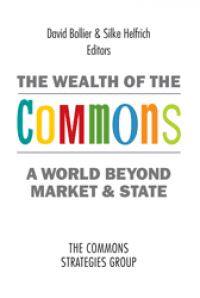
Six months after the print edition was published by our good friends at Levellers Press, I’m happy to report that the anthology of essays, The Wealth of the Commons:  A World Beyond Market and State, is now available online at http://www.wealthofthecommons.org

A hearty thanks once again to the commons activists, academics and project leaders from more than 25 countries who contributed the 73 essays in the book.  You can review the list of contributors and their essays here.  

The volume describes the enormous potential of the commons in conceptualizing and building a better future.  My colleague Silke Helfrich edited the German edition with the Heinrich Böll Foundation, which was published in Germany in April 2012.  Silke and I then edited a separate English edition published by Levellers last November. 

The five sections of the book give a good idea of its themes:  “The Commons as a New Paradigm”; “Capitalism, Enclosure and Resistance”; “Commoning – A Social Innovation for Our Times”; “Knowledge Commons for Social Change”; and “Envisioning a Commons-Based Policy and Production Framework.” 

The book chronicles many ongoing struggles against the private commoditization of shared resources – while documenting the immense generative power of the commons.  It explains how millions of commoners are defending their forests and fisheries, reinventing local food systems, organizing productive online communities, reclaiming public spaces, improving environmental stewardship and re-imagining the very meaning of “progress” and governance.   

We’re hoping that the online access to the book will help increase its visibility and readership – along with sales of the printed version.  I invite you to spread the word about book in your spheres of influence. 

Last November I was lucky enough to be in Berlin when the newly founded Mercator Research Institute for Global Commons and Climate Change (MCC) formally presented itself to the world.  I was initially impressed that a new scientific research institute with serious financial backing would make a commitment to studying climate change and the commons. The new Institute even regards the late Elinor Ostrom as a prime inspiration, to the extent of naming its auditorium for her.

I wondered if the new institute would be a fresh opening for some very different conversations about climate change.  I mused that perhaps the Mercator Research Institute could validate the eco-friendly practices of countless commoners around the world.  It might point the way to a different vision of “development” and more meaningful notions of “sustainability.”  It might even force the economics discipline to revisit some of its core assumptions about human cooperation and reinvent itself.

Alas, I now believe that few of these scenarios are likely.  After listening to the four speakers at the MCC’s inaugural one-day conference on November 15, “The Green Growth Dilemma,” the institute seems poised to explore modest, socially minded twists to the standard economic narrative.  In other words, a fairly tame, meliorist agenda within the crumbling edifice of neoclassical economic thought.

There will apparently be no deep critiques of the basic goals, assumptions and methodologies of economics as it is practiced today.  Nor does it seem that the potential of the commons as a form of participatory socio-ecological management will be probed.  That topic lies too far outside the framework of standard economics. Or at least, no one focused on such commons at the institute's inaugural conference.

In Berlin, Exploring What Is Commonable

On Tuesday evening, I gave a talk at the American Academy in Berlin, where I have been a residential fellow for the past five weeks.  I focused on the commons as “a new/old paradigm of governance,” making a survey of the topic in ways familiar to readers of this blog.  (Here is a video of the talk along with the text.)  It was fun to mix it up with a very diverse crowd that included academics, journalists, students, a Google Germany executive, a Wikipedia leader, a German patent law official, among many others.

Among the many interesting comments made by the audience, Katrin Faensen of The Virus,  coined a word that I am going to start using a lot:  “commonable.”  Faensen asked how she personally could become “more commonable” in the sense of connected to and participating in a commons.  I replied that she should start with whatever she is passionate about, and find a suitable commons project there.

I like “commonable” as a term because I think there will be a growing use for it in the future.  Tommaso Fattori of Italy has proposed new sorts of “commons/public” partnerships, for example, which could lead one to ask the question, “Is that public service or asset ‘commonable’?”  Many of us would like to see the earth’s atmosphere treated as a commons, which could lead to the statement, "We need to make the atmosphere commonable.”  My pleasure in the word was reinforced when another fellow here at the Academy, a renowned literary translator, agreed that the word has a promising future.

A word about the American Academy in Berlin.  This small, independent center in the Berlin suburb of Wannsee is dedicated to “advanced study in the humanities, public policy, social sciences and arts.”  Its central aim is to foster German/American cultural exchange via its Berlin Prize Fellowships.  I am pleased to say that I was selected for the Bosch Berlin Prize in Policy for fall 2012.  This has given me the gift of six weeks to read, study, think, meet with people, give talks and enjoy great food and stimulating company.  As a non-academic with no hope for a sabbatical, this has been a rare treat and a real joy. 

Berlin-Bound in November

I’m pleased to report that I will be visiting Berlin, Germany, as a residential fellow at the American Academy in Berlin for six weeks starting November 1.  As the winner of the Bosch Berlin Prize in Public Policy, I will be meeting with many commons scholars and activists, and studying the future of the commons movement. 

It will be a great opportunity for me to spend some time meeting with some leading thinkers and commons practitioners, including at the Heinrich Böll Foundation.  I also plan to do a lot of reading and thinking….and to learn from the other fellows at the Academy.  I haven’t had a lot of time for such things over the past several years because of my various book projects and speaking engagements. 

If you happen to be passing through Berlin in November, or if you live nearby, let me know.  I may be busy, but perhaps we could do coffee.

Eight Points of Reference for Commoning

One of the great achievements of the late Professor Elinor Ostrom was the identification of key design principles for successful commons.  She set forth eight of them in her landmark 1990 book, Governing the Commons.  The wording of those principles is aimed at social scientists who study the management of common-pool resources from a neutral, non-participatory, scientific perspective.  As a result, the principles are not as accessible to the general public, nor do they reflect the direct experiences and first-person voice of commoners.    

The first German Sommerschool on the Commons, which took place in Bechstedt/Thuringia in June 2012, decided to remedy this problem.  Participants took part in intense debates over what a new set of principles for commoning – based on the Ostrom principles – might look like if they reflected the personal perspective of commoners themselves.  The result is a statement, "Eight Points of Reference for Commoning,” which can be seen as a re-interpretation – remix? – of Ostrom's design principles.  

As Silke Helfrich notes on her Commonsblog, the Eight Points of Reference for Commoning “are based on the belief, that commons can flourish in very different contexts.”  The German version can be found here.  An English translation is below.  The German commoners consider the current wording of both the German and English versions as relatively stable, but they invite comments and suggestions for further changes.

At a time when representative democracy is increasingly revealed as ineffectual, phony or both – a kabuki theater of empty formalisms that disguise the offstage conspiracies of corporate/state elites – many people look to the Internet for salvation.  After all, the Internet is far more open, participatory and meritocratic than the closed, corporate-dominated process of our formal democracy. 

But even with these capacities, the Internet is not a solution because in the end the Internet is only a hosting platform.  A basic question must be answered:  How should a more serious deliberative democracy be structured in online spaces? 

Let the record show that the insurgent Pirate Party in Germany has made some significant progress on this problem.  Its new open source software platform, LiquidFeedback, is credited with helping the Pirates host more open, participatory and serious internal debates about party policies -- and to organize themselves to take action in conventional political arenas. 

The makers of Liquid Feedback characterize their platform in a mission statement as “a bridge between direct and representative democracy.”  They believe the software “has the potential to empower the ordinary members of mainstream political parties, making these parties more attractive to citizens and democracy stronger.”  The software, released in version 2.0 in March 2012, is currently used by several associations and political parties.

I’ve always been disappointed that the rich diversity of commons projects and scholarship that is exploding internationally cannot be readily seen – and what does exist tends to be written by and for academics. The International Commons Conference in Berlin in November 2010 brought this issue home by showing the amazing breadth of commons activism and thinking out there. The question is, How can someone tap into this knowledge? 

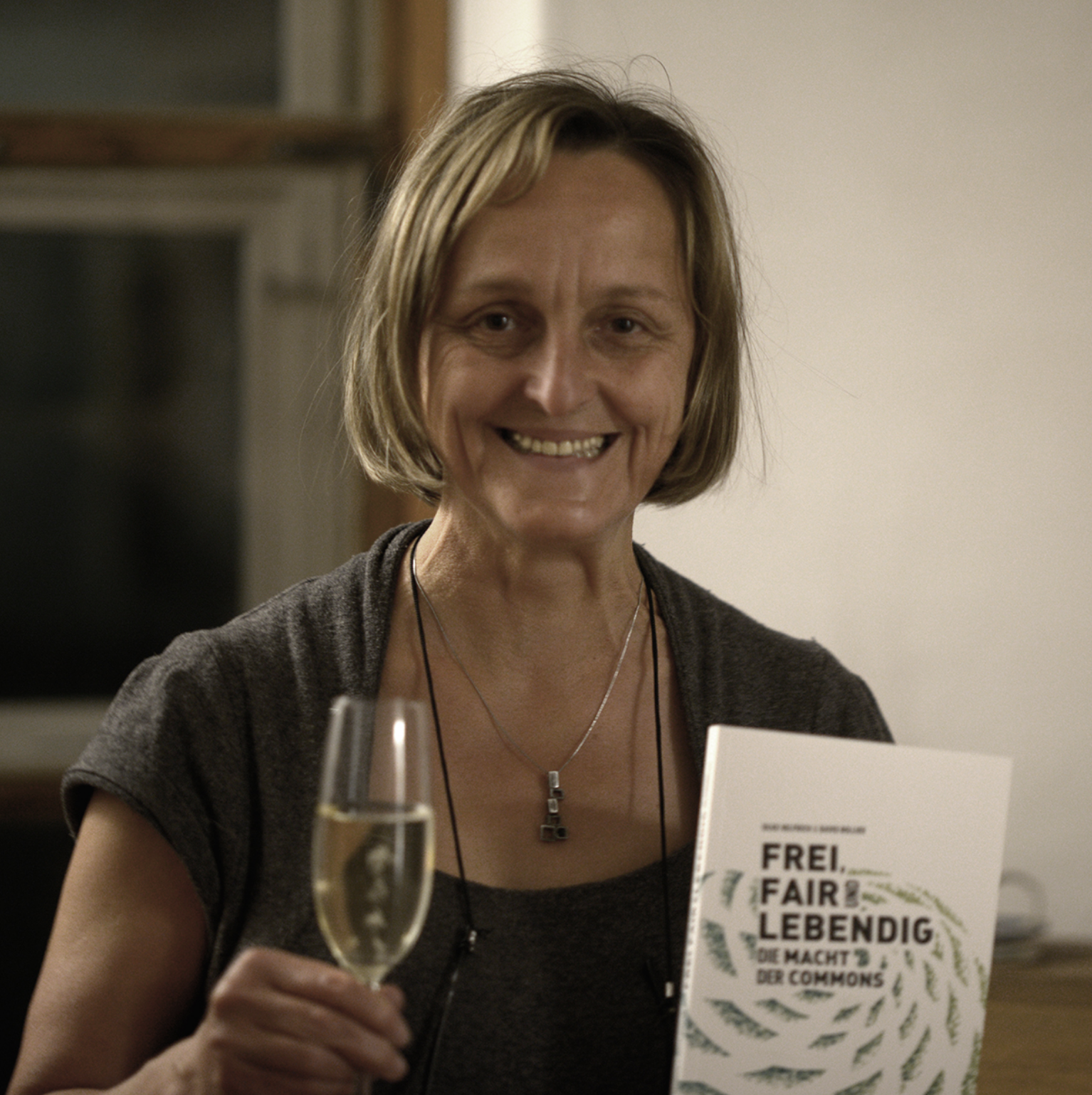
My friend and colleague Silke Helfrich and I have tried to remedy this problem by assembling a big anthology of essays on the commons by leading activists, scholars and project leaders.  I am happy to report that the German version of this book, edited by Helfrich and the Heinrich Böll Foundation, has just been published.  It’s called Commons:  For a Policy Beyond Market and State, and it's available from the German publisher, transcript. 

The 526-page book is likely to be a sourcebook on the commons for quite some time.  At least I hope so.  It contains 73 essays by authors who live in 30 countries around the world.  The essays focus on everything from commons-based abundance and free software to land enclosures and P2P urbanism.  There are essays by Peter Linebaugh on the history of the commons, Silvia Federici on women and the commons, Rob Hopkins on resilience, Liz Alden Wily on the international land grabs, Massimo de Angelis on capitalism and cooperation, and Hervé Le Crosnier on modern forms of enclosure, among many others. 

The point is to highlight the remarkable international diversity of commons projects, activism and theoretical thought.  The book features a number of essays by academics working in the Ostrom school of commons scholarship, but also many scholars from other traditions and independent activists. A major challenge was translating many essays from English and Spanish into German, and editing them all into a standard format.  A hearty congratulations to Silke and the Böll Foundationfor tackling this formidable task over the past year!

My commons colleague in Germany, Silke Helfrich, has pulled together a succinct, persuasive account of how the commons helps us get beyond the relentless growth imperatives of the contemporary economy.  She presented her ideas two weeks ago at the Attac Congress, “Beyond Growth,” in Berlin.  (A German version of her talk, “Commons Beyond Growth,” is available here.) 

Below is Silke’s penetrating analysis about how the commons can help cultivate practical new models of provisioning without the pathologies of compulsive, unsustainable growth:

Summary

  • Commons reduce money-induced growth because they make us more independent of money. The more we produce commons, the less we or the state has to pay for goods.
  • Commons reduce population-induced growth because they are associated with a multiplicity of sufficiency strategies which create prosperity by sharing.
  • Commons escape the growth compulsion, because all those things that are produced as commons, do not have to be made artificially scarce. And there is no incentive for artificial scarcity because commons are not produced as goods to be exchanged but they foster and maintain social relationships, satisfy needs and solve problems. Directly.

Thus far the vision of the future – but we have not got there yet. In the here and now a lot more must be thought through, discussed and fought for. Therefore, in what follows I will briefly give my reasoning.

The International Commons Conference in Berlin continues to generate some interesting follow-up work.  One of the most engaging is a series of videos shot by Alain Ambrosi of Remix the Commons.  The day after the conference, Alain interviewed ten commoners, including me, asking each of us the same questions, such as "What struck you most about this conference?"and "Would you say there is a commons movement?"

The Remix the Commons project is still a work-in-progress and won’t be fully operational for a few months.  However, in the meantime, two different series of videos are available:  “Define the Commons / Définir le Bien Commun / Definir el Procomùn,” and  “Framing the Commons in Berlin.”  The latter consists of a series of  nine separate interviews with  Silke Helfrich (Germany), Michel Bauwens (Thailand), Julio Lambing (Germany), Beatriz Busaniche (Argentina), Frédéric Sultan (France), Valérie Peugeot (France), Rosa Maria Fernanda (Ecuador), Alberto Acosta (Ecuador), Hervé Le Crosnier (France), and me.  Each interview is conducted in the interviewee’s native language.

Syndicate content