free software

By training Stefan Meretz is a German engineer and computer scientist, but he is also a deep theorist of the commons who has written often about commons-based peer production and the development of a free society beyond market and state.  Over the past several years I have learned a lot from Stefan's application of free software-inspired thinking to the commons.    

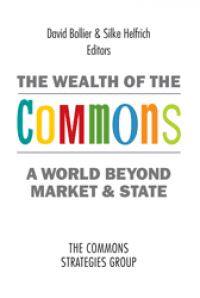
Below, I have posted his wonderful essay, “The Structural Communality of the Commons,” which appears in The Wealth of the Commons:  A World Beyond Market and State (Levellers Press).  Stefan lives in Berlin and blogs at www.keimform.de. 

This essay, like the rest of The Wealth of the Commons, is published under a Creative Commons Attribution-ShareAlike 3.0 license.  In coming weeks, I plan to post additional essays from our anthology.  All of them will all be available at www.wealthofthecommons.org starting in April.


The commons are as varied as life itself, and yet everyone involved with them shares common convictions. If we wish to understand these convictions, we must realize what commons mean in a practical sense, what their function is and always has been. That in turn includes that we concern ourselves with people. After all, commons or common goods are precisely not merely “goods,” but a social practice that generates, uses and preserves common resources and products. In other words, it is about the practice of commons, or commoning, and therefore also about us. The debate about the commons is also a debate about images of humanity. So let us take a step back and begin with the general question about living conditions.

Living conditions do not simply exist; instead, human beings actively produce them. In so doing, every generation stand on the shoulders of its forebears. Creating something new and handing down to future generations that which had been created before – and if possible, improved – has been part of human activity since time immemorial. The historical forms in which this occurred, however, have been transformed fundamentally, particularly since the transition to capitalism and a market economy. Although markets have existed for millennia, their function was not as central as they have become in contemporary capitalism, where they set the tone. They determine the rules of global trade. They organize interactions between producers and consumers across the world. Some observers believe they can recognize practices of the commons even in markets. After all, they say, markets are also about using resources jointly, and according to rules that enable markets to function in as unrestricted and unmanipulated ways as possible. However, markets are not commons, and it is worth understanding why.

Although markets are products of human action, their production is also controlled by markets, not by human action. It is no coincidence that markets are spoken of as if they were active subjects. We can read about what the markets are “doing” every day in the business pages. Markets decide, prefer and punish. They are nervous, lose trust or react cautiously. Our actions take place under the direction of the markets, not the other way around. Even a brief look at the rules mentioned above makes that clear. Rules issued by governments first recognize the basic principles of markets, but these rules function only as “add-ons” that are supposed to guide the effects of the markets in one direction or the other.

One direction may mean restricting the effects of the market so as to attain specific social goals. Viewed in this light, the supposedly alternative concept of a centrally planned economy turns out to be nothing more than a radical variant of guiding markets. The other direction can mean designing rules so that market mechanisms can flourish, in the hope that everyone is better off in the end if individuals pursue their own material self-interest. The various schools of economic thought reflect the different directions. They all take for granted the assumption that markets work, and that what matters is optimizing how they work. A common feature is that none of these standard schools of thought question markets themselves. That is why markets are at times described as “second nature” (Fisahn 2010) – a manifestation of nature and its laws that cannot be called into question, but only applied.
Cloud Computing as Enclosure

As more and more computing moves off our PCs and into “the Cloud,” Internet users are gaining access to a wealth of new software-based services that can exploit vast computing capacity and memory storage.  That’s wonderful.  But what about our freedom to create and share things as we wish, free from corporate or government surveillance or over-reaching copyright enforcement?  The real danger of the Cloud is its potential to limit how we may create and share what we want, on our terms.

There are already signs that large corporations like Google, Facebook, Twitter and all the rest will quietly warp the design architecture of the Internet to serve their business interests first.  A terrific overview of the troubling issues raised by the Cloud can be found in the essay, “The Cloud:  Boundless Digital Potential or Enclosure 3.0,” by David Lametti, a law professor at McGill University, and published by the Virginia Journal of Law & Technology.  An earlier version is available at the SSRN website.   

Lametti states his thesis simply:  “I argue that the Cloud, unless monitored and possibly directed, has the potential to go beyond undermining copyright and the public domain – Enclosure 2.0 – and to go beyond weakening privacy. This round, which I call “Enclosure 3.0”, has the potential to disempower Internet users and conversely empower a very small group of gatekeepers. Put bluntly, it has the potential to relegate Internet users to the status of digital sheep.”

The tech world frequently talks about open source software as a collaborative endeavor, but it is less apt to use the word “commons,” let alone engage in rigorous empirical analysis for understanding how software commons actually work.  The arrival of Internet Success:  A Study of Open-Source Software Commons (MIT Press) is therefore a welcome event.  This book is the first large-scale empirical study to look at the social, technical and institutional aspects of free, libre and open source software (often known as “FLOSS”).  It uses extensive firsthand survey research, statistical analysis and commons frameworks for studying this under-theorized realm.

While most people may associate open source software with Linux, there are in fact tens of thousands of open source projects in existence.  Many consist of no more than two or three participants, and may have only an irregular existence.  However, many thousands of others attract a small but spirited team, and still others are huge, robust social ecosystems in their own right.

The authors of Internet Success, UMass Professor Charles M. Schweik and consultant Robert C. English, looked at the large universe of FLOSS projects hosted on SourceForge.net, a website that functions as a kind of clearinghouse for over 260,000 FLOSS projects (as of February 2011) and 2.7 registered software developers.  The site provides most of the tools that developers need to find colleagues and build a new FLOSS program – a Web repository of code, bug-tracking utilities, online forums, email mailing lists, a wiki, file downloading services, etc. 

While SourceForge is not the only such site for FLOSS projects, it is the largest and arguably representative of the universe of such projects.  With support from the National Science Foundation, Schweik and English set out to study the pool of software development projects on SourceForge to try to determine why some succeed, why others fail and why others simply languish.  They explain in excruciating technical, social science detail how they assembled and analyzed their datasets, which originate in a vast collection of SourceForge data on more than 130,000 projects as well as their own survey questionnaire of programmers.  

Give Me My Data

Most Facebook users have become so accustomed to working on the “corporate plantation” as "digital sharecroppers" that they lose any interest in controlling their own digital lives and content.  It is a welcome development, therefore, to see enterprising souls like Owen Mundy develop a free app that lets people reclaim their data from their Facebook accounts.

Give Me My Data,  which is officially in “public-beta” release, is an attempt to give social network users control over their own stuff.  You might want to delete your account but retain your accumulated postings, for example.  Or you might want to get around the Facebook interface, archive your content or perhaps make artwork from it.  The content can be exported into a variety of common formats.

Give Me My Data is not only a useful free software tool (licensed under a Creative Commons Attribution-NonCommercial-ShareAlike license), it’s a way of sending a signal to the corporate goliath Facebook that users have some choices and just might decide to go elsewhere.   Mundy sees his app as a vehicle for public education:  “While clearly utilitarian,” he writes, “this project intervenes into online user experiences, provoking users to take a critical look at their interactions within social networking websites. It suggests data is tangible and challenges users to think about ways in which their information is used for purposes outside of their control by government or corporate entities."

I delivered the following remarks on May 11 as part of The Illahee Lecture Series 2011, "Searching for Solutions:  Innovation for the Public Good," in Portland, Oregon.

This evening, I’d like to get innovative about how we think about innovation itself.  The corporate cliché is to “think outside the box.”  That is such an inside-the-box way of thinking!  I say let’s get rid of the box!  Tonight I want to talk about a new vector of innovation:  how we’re going to manage our dwindling, finite natural resources and arrest the pathological growth imperatives of our economy while recovering a more sane, socially constructive way of life for human beings.  Now there’s a radical innovation challenge!

The subtext of most innovation-talk these days is efficiency and profitability.  Innovation is essentially the bigger-better-faster ethic – the next super-computer or bio-engineered cow or Segue scooter.  But the grim reality is that there are a whole class of societal problems that are not likely to become market opportunities,ever

Worse, conventional markets, in the course of creating new wealth, are generating all sorts of illth, in John Ruskin’s phrase – cost, unintended byproducts that must be put on the ledger sheet in any calculation of our supposed wealth.  Our market economy is generating whole new classes of illth such as  global warming, dying coral reefs, biodiversity loss and species extinctions.

The City of Linz in Austria has long been in the forefront of civic-minded uses of the Internet and digital technologies.  In 1979, it started the Ars Electronica festival, a showcase for cutting-edge experiments in digital and media arts, which was followed in 1987 with the Prix Ars Electronica, a prestigious international award for the most exemplary, pioneering websites and computer art.  In 2005 the city built 118 wifi hotspots in public squares so that citizens could have free access to the Internet.  Through the Public Space Server project, Linz began to provide personal e-mail inboxs on the city’s servers and to host non-commercial content on the Internet.

So it is exciting to learn that the City of Linz is now trying to take the free culture/open platform sensibility to a whole new level.  It wants to use the Internet to transform city politics, governance and culture into a vast ecosystem of commons.  Last July city officials announced that it would launch Open Commons Region Linz, a series of region-wide initiatives that aspires to make local information and creativity as open, accessible and shareable as possible.  The Green Party and politically minded digital leaders believe that by making it easy for citizens to access and share knowledge on a local basis, it will stimulate digital innovators to produce locally useful information tools while encouraging greater civic engagement and more robust economic development.

One of the recurrent questions that people have about the future of the Internet is, So how are creators going to make money in the digital environment?  The good news is that the Free Culture Forum – a Barcelona-based international gathering of free software, free culture, creators and policy activists – has addressed these very questions in a major “how to” guide that was just released.   

In “Sustainable Models for Creativity in the Digital Age,” the FCF affirms: 

We can no longer put off re-thinking the economic structures that have been producing, financing and funding culture up until now.  Many of the old models have become anachronistic and detrimental to civil society.  The aim of this document is to promote innovative strategies to defend and extend the sphere in which human creativity and knowledge can prosper freely and sustainably.

This report is aimed at policy reformers, citizens and free/libre culture activists to provide them practical tools to understand the policy options and revenue models, and the importance of the commons in the new digital marketplaces.

The U.S. Government’s ongoing crusade against WikiLeaks and the Egyptian Government’s shutdown of the Internet for five days force us to ask the question:  How shall the commoners retain their right to communicate with each other when their own governments intervene to stifle communications that threaten their power?

Eben Moglen, a long-time free software advocate, is promoting a great insurance policy:  decentralized, portable, personal servers.  He calls them “Freedom Boxes.”  The idea is that everyone should have a small, cheap personal server about the size of a cellphone charger.  Such devices already exist, he points out in today’s NYT, and cost about $99, and will likely become cheaper in coming months and years.  (A speech that Moglen gave on this topic, “Freedom in the Cloud,” on February 5, 2010, can be seen on YouTube here.  )

What’s missing at the moment is the software to make them easy to use.  So Moglen is calling upon the software programmers of the world to develop free software that could make the Freedom Box a viable, pervasive part of the Internet infrastructure.  We would no longer have to depend upon the good graces of a Google, Facebook or Internet service provider to reliably connect us or transact business for us.  We would have assured communications and commercial relationships without the threat of government interference or snooping, often through underhanded means.

Two weeks ago, I blogged about how Brazil is turning its back on the free software and free culture movements, and moving to defend entrenched, proprietary cultural industries:  a terribly disappointing turn of events.  Now there is an international petition being circulated in Portuguese, French, Spanish and English to express widespread dismay at this recent turn of events. A copy of the petition is below.  You can sign it by going to this website.

The petition follows:

(English translation of the Carta de representantes da sociedade civil à Presidente Dilma Roussef e à Ministra da Cultura Ana Buarque de Hollanda)


Academia as a Commons:

The Promise of Digital Technologies at Amherst College and the Five Colleges

The following remarks were made by David Bollier, Croxton Lecturer at the Robert Frost Library, Amherst College, on April 26, 2010.

I am particularly pleased to be delivering these remarks in Frost Library, ground zero for my intellectual wanderlust as an Amherst student, class of 1978.  Libraries are also a deep part of my family tradition.  My father was for many years a librarian at Yale Divinity School Library, and so it pleases me to be able to do my part to support my local library. 

Allow me to make a quick introduction of myself so you can get a sense of my mission in life.  I am not an academic, although I am currently pretending to be one as the Croxton Lecturer here at Amherst College.  I’m teaching Sociology 42, a seminar called “The Rise of the Commons,” which draws upon my extensive writing and thinking about the commons.            

Syndicate content