books

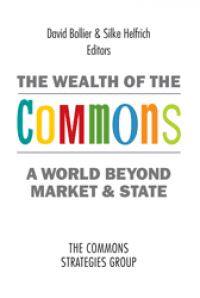
Six months after the print edition was published by our good friends at Levellers Press, I’m happy to report that the anthology of essays, The Wealth of the Commons:  A World Beyond Market and State, is now available online at http://www.wealthofthecommons.org

A hearty thanks once again to the commons activists, academics and project leaders from more than 25 countries who contributed the 73 essays in the book.  You can review the list of contributors and their essays here.  

The volume describes the enormous potential of the commons in conceptualizing and building a better future.  My colleague Silke Helfrich edited the German edition with the Heinrich Böll Foundation, which was published in Germany in April 2012.  Silke and I then edited a separate English edition published by Levellers last November. 

The five sections of the book give a good idea of its themes:  “The Commons as a New Paradigm”; “Capitalism, Enclosure and Resistance”; “Commoning – A Social Innovation for Our Times”; “Knowledge Commons for Social Change”; and “Envisioning a Commons-Based Policy and Production Framework.” 

The book chronicles many ongoing struggles against the private commoditization of shared resources – while documenting the immense generative power of the commons.  It explains how millions of commoners are defending their forests and fisheries, reinventing local food systems, organizing productive online communities, reclaiming public spaces, improving environmental stewardship and re-imagining the very meaning of “progress” and governance.   

We’re hoping that the online access to the book will help increase its visibility and readership – along with sales of the printed version.  I invite you to spread the word about book in your spheres of influence. 

It’s been two years since my dear friend and commons activist Jonathan Rowe went to the gym, came down with an illness and unexpectedly passed away at age 65.  Jon was one of the cofounders, in 2002, of the Tomales Bay Institute, later renamed On the Commons.  Over the course of the next ten years I learned a great deal about the commons from my many conversations with Jon and from his unfailingly beautiful essays and blog posts.  It is a bittersweet experience to re-encounter Jon’s work in all its understated glory in a new book just published. 

Our Common Wealth:  The Hidden Economy That Makes Everything Else Work (Berrett-Koehler) consists of 22 short pieces that Jon wrote for various magazines and Onthecommons.org.  The book offers a series of meditations on various aspects of the commons, markets, property and the human condition.  Each of them is brisk, passionate and lucid. 

If you’re not familiar with Jon, you may want to sample his writings at the website established in his memory after his death, www.jonathanrowe.org. You should also read the book, which will stand as an elegant, sensitive introduction to the commons for years to come. 

I’m grateful to my commons colleague and friend Peter Barnes for foraging through Jon’s eclectic and diverse writings to edit this volume.  Peter, who worked with Jon and me, is the originator of the cap-and-dividend / Sky Trust proposal for curbing climate emissions.  (See his books, Who Owns the Sky? and Capitalism 3.0.)  Peter wrote the book’s introduction, and Bill McKibben and I have small cameos as writers of the book’s foreword and afterword, respectively.

While many publishers might be wary of bringing out what might be seen as a “tribute book,” Jon’s essays shine forth as underappreciated gems that will have a timeless appeal.  He was that good a writer. 

What impressed me about Jon was how he drew upon a rich well of political activism, Washington contacts and top-flight journalists while living a fairly simple life in the rural village of Point Reyes Station, California.  It gave him time to think and reflect on contemporary political culture, and it made his commentary that much more penetrating and deep.  For a fuller account of Jon’s life and career, you may want to read the appreciation that I wrote two years ago, shortly after his death. 

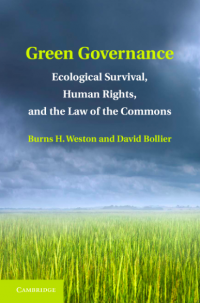
After three years of hard work, I am pleased to announce that my new book – co-authored with Professor Burns Weston of the Center for Human Rights at the University of Iowa College of Law – has just been published.  Green Governance:  Ecological Survival, Human Rights and the Law of the Commons was recently released by Cambridge University Press.  Here is a short summary of the book:

The vast majority of the world’s scientists agree: we have reached a point in history where we are in grave danger of destroying Earth's life-sustaining capacity.  But our attempts to protect natural ecosystems are increasingly ineffective because our very conception of the problem is limited; we treat “the environment” as its own separate realm, taking for granted prevailing but outmoded conceptions of economics, national sovereignty, and international law.  Green Governance is a direct response to the mounting calls for a paradigm shift in the way humans relate to the natural environment.  It opens the door to a new set of solutions by proposing a compelling new synthesis of environmental protection based on broader notions of economics and human rights and on commons-based governance.  Going beyond speculative abstractions, the book proposes a new architecture of environmental law and public policy that is as practical as it is theoretically sound.

The book has a number of significant endorsements.  At the risk of immodesty, here are a few of the blurbs for Green Governance:

James Gustave Speth, Former Dean, Yale School of Forestry and Environmental Studies, and Professor of Law, Vermont Law School:

“When a vital body of existing policy and law has run its course, the need for reinvention becomes urgent. So it is with environmental law and policy. It is therefore exiting that two enormously well-informed and creative thinkers, Burns Weston and David Bollier, have joined forces to produce this breakthrough in environmental governance. Their book is a landmark in our thinking about rights-based environmentalism and the law of the commons and how these fields can combine in a powerful synthesis. We must take these ideas very seriously indeed. Highly recommended.”

Why the Language of the Commons Matters

The text below is the second half of the Introduction to the recently published anthology of essays, The Wealth of the Commons:  A World Beyond Market and State (Levellers Press).  The first half was posted yesterday.  More about the book can be found at www.wealthofthecommons.org.

As the corruption of the market/state duopoly has deepened, our very language for identifying problems and imagining solutions has been compromised. The snares and deceptions embedded in our prevailing political language go very deep. Such dualisms as “public” and “private,” and “state” and “market,” and “nature and culture,” for example, are taken as self-evident. As heirs of Descartes, we are accustomed to differentiating “subjective” from “objective,” and “individual” from “collective” as polar opposites. But such polarities are lexical inheritances that are increasingly inapt as the two poles in reality blur into each other. And yet they continue to profoundly structure how we think about contemporary problems and what spectrum of solutions we regard as plausible.

Words have performative force. They make the world. In the very moment that we stop talking about business models, efficiency and profitability as top priorities, we stop seeing ourselves as homo economicus and as objects to be manipulated by computer spreadsheets. We start seeing ourselves as commoners in relationship to others, with a shared history and shared future. We start creating a culture of stewardship and co-responsibility for our commons resources while at the same time defending our livelihoods. This new language situates us as interactive agents of larger collectivities. Our participation in these larger wholes (local communities, online affinity groups, inter-generational traditions) does not eradicate our individuality, but it certainly shapes our preferences, outlooks, values and behaviors: who we are. A key revelation of the commons way of thinking is that we humans are not in fact isolated, atomistic individuals. We are not amoebas with no human agency except hedonistic “utilitarian preferences” that are expressed in the marketplace.

No: We are commoners – creative, distinctive individuals inscribed within larger wholes. We may have many unattractive human traits fueled by individual fears and ego, but we are also creatures entirely capable of self-organization, cooperation, a concern for fairness and social justice, and sacrifice for the larger good and future generations.

The Commons as a Transformative Vision

Below is the first half of the Introduction to our new anthology of essays, The Wealth of the Commons:  A World Beyond Market and State, just published by Levellers Press.  The Introduction is by me and Silke Helfrich, my co-editor and colleague on the Commons Strategies Group.  Part II of the essay will be published in my next blog post.  You can learn more about the book at its website, www.wealthofthecommons.org.

It has become increasingly clear that we are poised between an old world that no longer works and a new one struggling to be born. Surrounded by an archaic order of centralized hierarchies on the one hand and predatory markets on the other, presided over by a state committed to planet-destroying economic growth, people around the world are searching for alternatives. That is the message of various social conflicts all over the world--of the Spanish Indignados and the Occupy movement, and of countless social innovators on the Internet. People want to emancipate themselves not just from poverty and shrinking opportunities, but from governance systems that do not allow them meaningful voice and responsibility. This book is about how we can find the new paths to navigate this transition. It is about our future.

But since there is no path forward, we must make the path. This book therefore is about some of the most promising new paths now being developed. Its seventy-three essays describe the enormous potential of the commons in conceptualizing and building a better future. The pieces, written by authors from thirty countries, fall into three general categories – those that offer a penetrating critique the existing, increasingly dysfunctional market/state partnership; those that enlarge our theoretical understandings of the commons as a way to change the world; and those that describe innovative working projects that are demonstrating the feasibility and appeal of the commons.

I’m pleased to report that the English edition of a new anthology of essays, The Wealth of the Commons:  A World Beyond Market and State, is now available!  I’ve been working on editing the book with my German colleague Silke Helfrich for nearly a year and a half, so it’s wonderfully satisfying to see the book in its final, printed form. 

Let me immodestly state:  Never before have so many different international voices about the commons been brought together in one volume.  The Wealth of the Commons consists of 73 essays by a diverse roster of international activists, academics and project leaders. It consists of descriptions of specific commons innovations, essays on the theory and economics of commons, accounts of different types of enclosures around the world, and much else.

There are accounts of fishing commons off the coast of Chile; fruit sharing from abandoned orchards in Germany; and an overview of subsistence forestry in Nepal.  There are many accounts of market enclosures, from dam-building in India to mining in South America to the international land grab now underway in Africa and Asia.  The book also features a series of essays on knowledge commons and more than a dozen essays focused on commons-friendly policy innovations.

The soft-bound, 442-page book is published by Levellers Press, a small, innovative publisher here in Massachusetts that is also a worker coop and itself ardently committed to the commons.  I love the fact that a book on the commons is being published by a publisher that truly honors the Levellers, one of the great movements of commoners in the seventeenth century.  The book can be bought from the Levellers website for US$22.50 plus shipping and handling.  More about the book can be found on its website, www.wealthofthecommons.org

Raj Patel has been tracking the pathologies of the global food system for many years.  An activist and academic who teaches at the UC Berkeley Center for African Studies, Patel has just published a second, updated edition of his 2008 book, Stuffed and Starved The Hidden Battle for the World Food System

The problem with the food system is not that we don't produce enough calories to eradicate hunger, Patel notes.  It's that the food system has its own priorities of institutional consolidation and profit, which means that more than 1 billion people in the world are malnourished and 2 billion are overweight – which is worse than when the first edition of Patel's book came out. 

Patel has also been a serious student of the commons.  His 2010 book, The Value of Nothing:  How to Reshape the Market Society and Redefine Democracy, is a lucid overview of the fallaciious premises of market economics and its dismal performance.  He also goes on at length about the ability of the commons paradigm to help ameliorate food sovereignty, environmental sustainability and social justice.

Recommended reading is a recent interview with Patel at Stir, the vigorous, commons-oriented British political journal founded by Jonathan Gordon-Farleigh.  (Incidentally, Stir is in the midst of a Kickstarter campaign to pay for a print run of a book collecting some of its best articles.)

Here are a few excerpts from Stir’s interview with Patel:   

On genetically modified crops & climate change:  “We have an increasing amount of evidence to suggest that agro-ecological farming systems will be able to feed the world in the future.  The GM advocates are saying, “What about drought-resistance and climate-change-ready crops?” That seems to be nonsense!  To have a crop that is climate-change-ready is ludicrous because change is precisely change — it is so many different things.  It could be new pests, rains coming at the wrong time; it could be too much rain, or too much heat.  It is impossible to have a single crop that is ready for those possible changes.  We’ve already seen the limits of that because Monsanto has a product called ‘Drought Guard’ — a genetically-modified crop that performs no better than any conventional crop in resisting anything but a mild drought.  The problem with this is that climate change isn’t about mild anything but extreme weather events.”

Share or Die, the Book

When Dustin Hoffman was “the graduate,” he could at least consider a job in plastics.  Nowadays the jobs have been sent abroad, communities are being destabilized by budget cuts, and many of the entry-level opportunities for young people, if they exist at all, are pretty soul-deadening.  The world that is being bequeathed to the younger generation is in serious decline if not decadence – yet the corporate and political elite who run the show seem incapable of turning things around.  Indeed, they don’t really seem to want to.  What’s a twenty-something supposed to do?

Shareable Magazine has just released a lively book that provides a few answers.  It doesn't offer any grand manifestos so much as a series of highly personal, evocative testimonies filled with rays of hope.  Share or Die:  Voices of the Get Lost Generation in the Age of Crisis, is an eclectic collection of essays about the ways that young people are trying to build happier, wholesome, workable lives for themselves as the edifice of late-stage capitalism begins to implode.  Edited by Malcolm Harris with Neal Gorenflo (New Society Publishers), the book brings to the surface, in authentic, heartfelt ways, the frustrations and triumphs of young people trying to find their footings.

Here are some of those voices: 

An anonymous, self-described “nomad” describes why he has chosen of life on the road.  It’s not as if he has a script or a deadline for his travels; he’s just wandering.  He advises, “You need to be resourceful and confident, reasonably streetwise, but also open to the prospect that most people are basically good.  The kindness of people I meet on the road continues to overwhelm me, and I aim to both repay it and pass it on as far as possible.”  The nomad itemizes what’s in his backpack (his netbook, ancient mobile phone and waterproof jacket), and why.

It’s unlikely that we are ever going to get a book as rigorous and comprehensive in its treatment of infrastructure as a commons than Professor Brett Frischmann’s recently published Infrastructure: The Social Value of Shared Resources (Oxford University Press). This book is a landmark in the study of the social value of infrastructure, a theme that is generally overlooked or marginalized.

Who among us gives much thought to the economics and policy structures that govern the Internet, telecommunications, water systems, roads and highways or the electric power grid?  These resources hover in the background, nearly invisible, until they break down.  Then people start to contemplate the wide-ranging social, economic and civic benefits of safe bridges and reliable, efficient water systems. And if we're lucky, prudent policies are enacted.

Infrastructure tends to be neglected because it is generally very complex, technologically and financially.  Its value extends well into the future and so it’s easy to ignores its benefits.  And since the benefits also tend to be diffused among the general public, there is often no single individual constituency to rally behind infrastructure except those who directly profit from it.

Not surprisingly, lots of private interests have made great fortunes by privatizing public infrastructure.  Since deregulation in the 1990s, the broadcasting industry has enjoyed exclusive control over our airwaves with no meaningful public interest obligations – an enclosure worth hundreds of billions of dollars.  The atmosphere is used as a free waste dump by polluters.  Multinational bottlers continually prowl the globe in search of free or cheap groundwater supplies while other attempt to privatize municipal water systems.

For the past two years or more, I’ve been working on a major research and writing project to try to recover from the mists of history the bits and pieces of what might be called “commons law” (not to be confused with common law).  Commons law consists of those social practices, cultural traditions and specific bodies of formal law that recognize the rights of commoners to manage their own resources.  Most of these governance traditions deal with natural resources such as farmland, forests, fisheries, water and wild game.  Commons law has existed in many forms, and in many cultures, over millennia.

Ever since the rise of the nation-state and especially industrialized markets, however, commons law has been marginalized if not eclipsed by contemporary forms of market-based law.  Over the past 200 years, individual property rights and market exchange have been elevated over most everything else, and this has only eroded the rights of commoners, it has contributed to the destruction of the Earth and its fragile natural systems.

To address this problem, the noted international law and human rights scholar, Professor Burns Weston of the University of Iowa School of Law, and I started the Commons Law Project in 2010.  We wanted to re-imagine the scope of human rights law, validate neglected forms of commons-based ecological governance and reframe the very notion of “the economy” to incorporate non-market sharing and collaboration.

It has been, I concede, an ambitious enterprise.  But we had concluded that incremental efforts to expand human rights and environmental protection within the framework of the State/Market duopoly were simply not going to achieve much.  Indeed, the existing system of regulation and international treaties has been a horrendous failure over the past forty years.  Neoliberal economics has corrupted and compromised law and regulation, slashing away at responsible stewardship of our shared inheritance while hastening a steady decline of the world’s ecosystems – forests, wetlands, fisheries, coral reefs, the atmosphere, the polar zones, and more.

Syndicate content