The Commons as a Transformative Vision

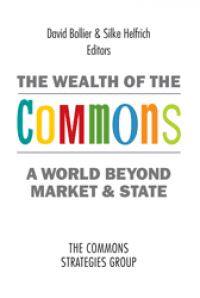
Below is the first half of the Introduction to our new anthology of essays, The Wealth of the Commons:  A World Beyond Market and State, just published by Levellers Press.  The Introduction is by me and Silke Helfrich, my co-editor and colleague on the Commons Strategies Group.  Part II of the essay will be published in my next blog post.  You can learn more about the book at its website, www.wealthofthecommons.org.

It has become increasingly clear that we are poised between an old world that no longer works and a new one struggling to be born. Surrounded by an archaic order of centralized hierarchies on the one hand and predatory markets on the other, presided over by a state committed to planet-destroying economic growth, people around the world are searching for alternatives. That is the message of various social conflicts all over the world--of the Spanish Indignados and the Occupy movement, and of countless social innovators on the Internet. People want to emancipate themselves not just from poverty and shrinking opportunities, but from governance systems that do not allow them meaningful voice and responsibility. This book is about how we can find the new paths to navigate this transition. It is about our future.

But since there is no path forward, we must make the path. This book therefore is about some of the most promising new paths now being developed. Its seventy-three essays describe the enormous potential of the commons in conceptualizing and building a better future. The pieces, written by authors from thirty countries, fall into three general categories – those that offer a penetrating critique the existing, increasingly dysfunctional market/state partnership; those that enlarge our theoretical understandings of the commons as a way to change the world; and those that describe innovative working projects that are demonstrating the feasibility and appeal of the commons.

I’m pleased to report that the English edition of a new anthology of essays, The Wealth of the Commons:  A World Beyond Market and State, is now available!  I’ve been working on editing the book with my German colleague Silke Helfrich for nearly a year and a half, so it’s wonderfully satisfying to see the book in its final, printed form. 

Let me immodestly state:  Never before have so many different international voices about the commons been brought together in one volume.  The Wealth of the Commons consists of 73 essays by a diverse roster of international activists, academics and project leaders. It consists of descriptions of specific commons innovations, essays on the theory and economics of commons, accounts of different types of enclosures around the world, and much else.

There are accounts of fishing commons off the coast of Chile; fruit sharing from abandoned orchards in Germany; and an overview of subsistence forestry in Nepal.  There are many accounts of market enclosures, from dam-building in India to mining in South America to the international land grab now underway in Africa and Asia.  The book also features a series of essays on knowledge commons and more than a dozen essays focused on commons-friendly policy innovations.

The soft-bound, 442-page book is published by Levellers Press, a small, innovative publisher here in Massachusetts that is also a worker coop and itself ardently committed to the commons.  I love the fact that a book on the commons is being published by a publisher that truly honors the Levellers, one of the great movements of commoners in the seventeenth century.  The book can be bought from the Levellers website for US$22.50 plus shipping and handling.  More about the book can be found on its website, www.wealthofthecommons.org

Can we begin to reconceptualize how we interact with Nature and afford it the legal protections that are now available only to people?  Along with Bolivia and Ecuador, New Zealand appears to be in the vanguard of this fascinating, welcome trend. 

In his blog about the Northern Territory of New Zealand, Bob Gosford reports that a court there “has recognised – perhaps for the first time in legal history – that a river has personality sufficient to allow it to be heard in a court of law.”  (A tip of the hat to Tim Gregory for passing this news along.)  Gosford cites reporter Kate Shuttleworth in the New Zealand Herald:

The Whanganui River will become an legal entity and have a legal voice under a preliminary agreement signed between Whanganui River iwi [“peoples” in Maori] and the Crown tonight. This is the first time a river has been given a legal identity. A spokesman for the Minister of Treaty Negotiations said Whanganui River will be recognised as a person when it comes to the law – “in the same way a company is, which will give it rights and interests” … Under the agreement the river is given legal status under the nameTe Awa Tupua – two guardians, one from the Crown and one from a Whanganui River iwi, will be given the role of protecting the river.

Shareable.net has published a terrific interview with Marxist geographer David Harvey on the future of cities as a place for commoning.  It’s a timely conversation now that many people believe that cities, not nation-states, will be the focus for economic and political renewal. 

Harvey, the author of such insightful books as A Short Introduction to Neoliberalism, The Enigma of Capital and Rebel Cities, spoke with San Francisco activist Chris Carlsson, who is co-director of the multimedia history project Shaping San Francisco (a wiki-based digital archive at foundsf.org).  Carlsson is also a writer, publisher, editor, and community organizer.

Shareable publisher Neal Gorenflo introduces the interview by noting that so much of the conversation about renewing cities ignores a basic reality:  "The commons is the goose that lays the golden eggs. Without the commons, there is no market or future. If every resource is commodified, if every square inch of real estate is subjected to speculative forces, if every calorie of every urbanite is used to simply meet bread and board, then we seal off the future. Without commons, there’s no room for people to maneuver, there’s no space for change, and no space for life. The future is literally born out of commons."

Here are a few excerpts from Carlsson's interview with Harvey.  Consider these passages a tease designed to get you to wander over to Shareable to read the entire thing.

Berlin-Bound in November

I’m pleased to report that I will be visiting Berlin, Germany, as a residential fellow at the American Academy in Berlin for six weeks starting November 1.  As the winner of the Bosch Berlin Prize in Public Policy, I will be meeting with many commons scholars and activists, and studying the future of the commons movement. 

It will be a great opportunity for me to spend some time meeting with some leading thinkers and commons practitioners, including at the Heinrich Böll Foundation.  I also plan to do a lot of reading and thinking….and to learn from the other fellows at the Academy.  I haven’t had a lot of time for such things over the past several years because of my various book projects and speaking engagements. 

If you happen to be passing through Berlin in November, or if you live nearby, let me know.  I may be busy, but perhaps we could do coffee.

The Linkages Between Money & Community

The relationship between money and community is not very obvious if only because we tend to regard money as a “real thing,” not an artificial social creation and abstraction.  Fortunately, a recent essay in Cultural Anthropology Online (May 2012) offers some helpful insights into the ways in which money and community are inextricably connected. 

In “Community and Money, Local and European,” Luigi Doria of Centre Maurice Halbwachs, Paris, and Luca Fantacci of Bocconi University, Milan, ask us to consider the “very co-belongingness” of community and money.  The authors start by noting that “knowingly or unknowingly, monetary institutions always embody a representation of man in society.  The functions that are given to a certain form of money correspond to a certain conception of what exchange, debt and credit mean for a society.”

And what might that be in modern, industrialized societies?  It is to be socially independent and disconnected.  Modern humans make a “fetish” of liquidity, as John Maynard Keynes put it.  It is considered a supreme virtue to be able to hold as much of one’s wealth as one can in forms that can be easily converted into cash.  Liquidity = freedom.  The dirty little secret is that not everyone can achieve this ideal because if everyone tried to cash in and hold liquid assets, the entire system will collapse. 

Imagining “Economic Degrowth”

Boosting economic growth is such a central element of modern political culture that few people truly consider whether it is ecologically sustainable.  It's not, as the twin specters of Peak Oil and climate change are demonstrating.  We desperately need some serious thinking about how to move from the “growth paradigm” as the default goal of our economy to an economy that structurally requires less energy and material throughput.  One term that has come to describe this vision is “degrowth.”  In fact, a major international conference on “Degrowth, Ecological Sustainability and Social Equity” will be held in Venice, Italy, on September 19-23. 

As part of that ongoing conversation, Austrians Andreas Exner and Christian Lauk recently published a thoughtful essay in Solutions magazine on “Social Innovations for Economic Degrowth.”  The piece focuses on how the Solidarity Economy and the global information commons offer a template for moving to a no-growth economy -- that is, an economy that uses less energy and material while increasing personal leisure and well-being. 

Exner and Lauk consider the models pioneered by the Solidarity Economy in Brazil in the late 1990s when that country “was hit by an economic crisis caused by the liberalization of capital markets.”  As bankruptcies and unemployment rose, poor people joined together with trade unions, universities and others to create cooperatives and other enterprises to meet people’s needs.  But the innovations were not just business models but social habits and practices that let people work together to meet basic needs without the relentless imperative to grow and chew up the natural environment.

In the latest issue of Stir to Action, John Gurney, an historian of the Diggers of the 17th century, has some fascinating perspectives on the Runnymede Eco-Village, a squatters encampment that began in June near the site where the Magna Carta was signed by King John.  In his essay, “The Diggers, the Land and Direct Activism,” Gurney reflects on the parallels between today’s encampment and a similar one that occurred in April 1649:

"It was in April 1649 that the Diggers, inspired by the writings of Gerrard Winstanley, occupied waste land on St George’s Hill in Surrey, and sowed the ground with parsnips, carrots and beans. For Winstanley, the earth had been corrupted by covetousness and the rise of privatge property, and the time was ripe for it tobecome once more a ‘common treasury for all’. Change was to be brought about by the poor working the land in common and refusing to work for hire. The common people had ‘by their labours … lifted up their landlords and others to rule in tyranny and oppression over them’, and, Winstanley insisted, ‘so long as such are rulers as calls the land theirs … the common people shall never have their liberty; nor the land ever freed from troubles, oppressions and complainings’. The earth was made ‘to preserve all her children’, and not to ‘preserve a few covetous, proud men to live at ease, and for them to bag and barn up the treasures of the earth from others, that they might beg or starve in a fruitful land’ – everyone should be able to ‘live upon the increase of the earth comfortably’. Soon all people – rich as well as poor – would, Winstanley hoped, be persuaded to throw in their lot with the Diggers and work to create a new, and better society. To Winstanley, agency was key, for ‘action is the life of all and if thou dost not act, thou dost nothing’.

….Digging lasted for just over a year from April 1649. The Surrey Diggers abandoned their St George’s Hill colony in the summer of 1649, after having succumbed to frequent assaults and legal actions, and by late August they had relocated to the neighbouring parish of Cobham. Here they remained until 19 April 1650, when local landowners brought hired men to destroy their houses and burn the contents and building materials. New Digger colonies had, however, sprung up elsewhere, inspired by the Surrey Diggers’ example and by Winstanley’s extraordinarily rich body of writings.

Eight Points of Reference for Commoning

One of the great achievements of the late Professor Elinor Ostrom was the identification of key design principles for successful commons.  She set forth eight of them in her landmark 1990 book, Governing the Commons.  The wording of those principles is aimed at social scientists who study the management of common-pool resources from a neutral, non-participatory, scientific perspective.  As a result, the principles are not as accessible to the general public, nor do they reflect the direct experiences and first-person voice of commoners.    

The first German Sommerschool on the Commons, which took place in Bechstedt/Thuringia in June 2012, decided to remedy this problem.  Participants took part in intense debates over what a new set of principles for commoning – based on the Ostrom principles – might look like if they reflected the personal perspective of commoners themselves.  The result is a statement, "Eight Points of Reference for Commoning,” which can be seen as a re-interpretation – remix? – of Ostrom's design principles.  

As Silke Helfrich notes on her Commonsblog, the Eight Points of Reference for Commoning “are based on the belief, that commons can flourish in very different contexts.”  The German version can be found here.  An English translation is below.  The German commoners consider the current wording of both the German and English versions as relatively stable, but they invite comments and suggestions for further changes.

A major San Francisco museum that celebrates a “hands-on, learning-by-doing ethos” plans to present an exhibit about the commons by letting people experience a taste of its dynamics.  As reported in today’s New York Times, the Exploratorium will open a new $220 million facility along the Embarcadero next spring, where it will likely attract larger crowds.  The museum will have three times more exhibition space than its current facility, and it will feature exhibits dealing with the environment, microbiology and social psychology.

As the Times reports:

Prototypes have already been tested on the floor of the current Exploratorium. In one social psychology exhibit, some items of modest value, like a calculator were put out at the beginning of the day. Visitors were told they could take an item, provided they replace it with something else.

“The goal of this is to have a ‘tragedy of the commons’ situation,” said Hugh McDonald, one of the curators of a new gallery, which will focus on human behavior. “This table is a commons. It’s up to you to maintain it with the quality of interesting stuff.”

If people do not, he said, participants learn that “it turns to trash.”

Syndicate content